



… says digital violations have become more sophisticated
The Director-General, Nigerian Copyright Commission (NCC), Dr. John O. Asein, has emphasised the significance of strategic leadership, digital transformation for effective copyright enforcement.
Piracy has become more sophisticated, digital violations move across borders instantly, adding that artificial intelligence is disrupting long-held assumptions about creativity, ownership, and authorship. “In many ways, the future has arrived faster than institutions were prepared for. And this is why leadership matters, he noted.
“Not leadership as title or ceremony, but leadership as clarity of thought, strength of judgment, and the courage to prepare institutions for realities that do not yet fully exist. Strategic leadership today requires more than administrative competence. It requires imagination. It requires adaptability. And above all, it requires the discipline to think beyond the pressures of the moment,” he said.
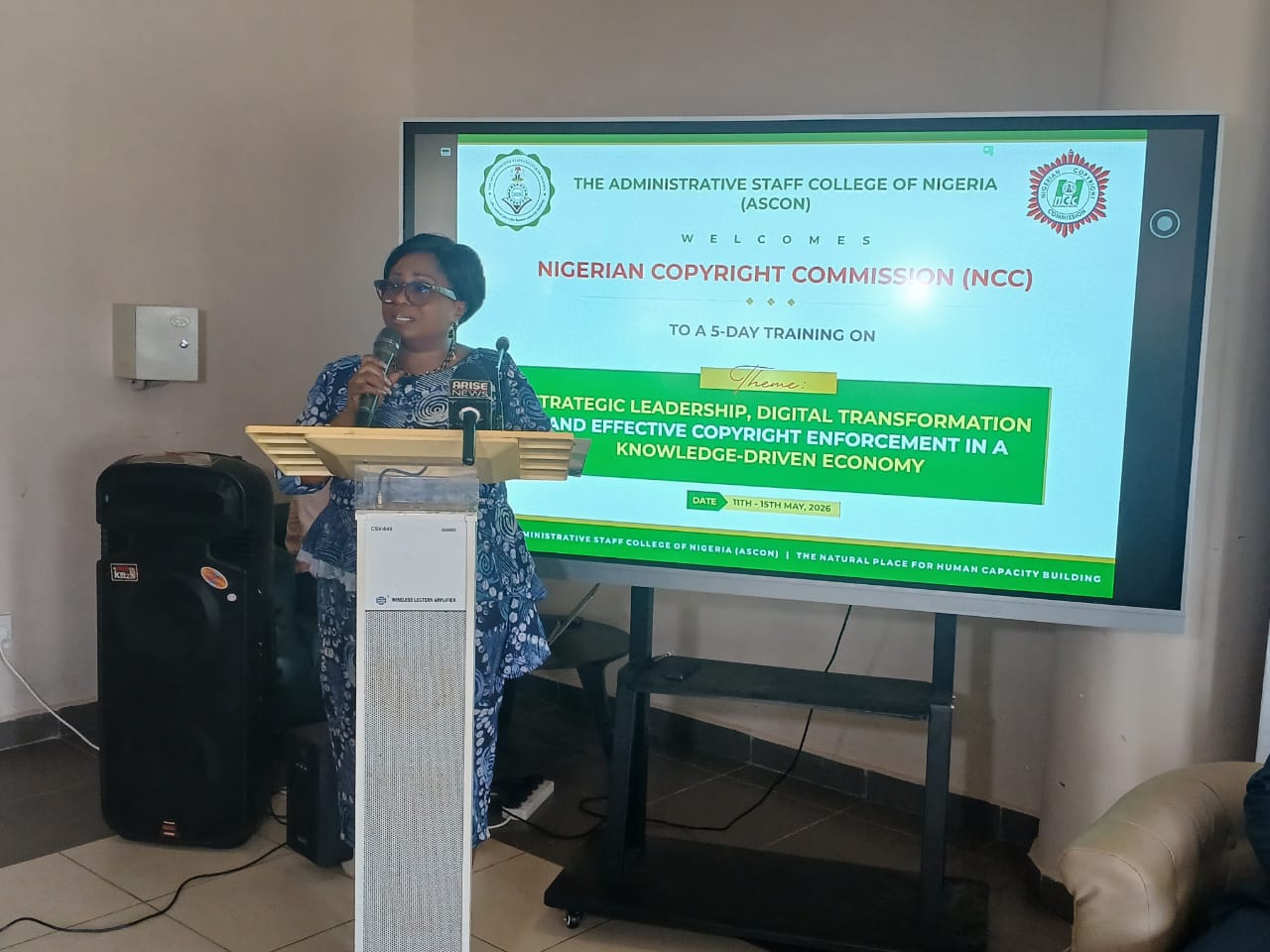
On Tuesday, Dr. Asein, speaking at the opening ceremony of the workshop for NCC officers on Grade Levels 13 and 14, holding at the serene Administrative Staff College of Nigeria (ASCON), Badagry, Lagos, the retreat theme: “Strategic Leadership, Digital Transformation and Effective Copyright Enforcement in a Knowledge-Driven Economy”, speaks “directly to the times we are living in. Because in this digital age, institutions cannot afford to be passive observers of change. We must become intelligent navigators of change.
Real transformation begins with mindset, how we think, how we make decisions, how willing we are to challenge outdated assumptions, and whether we have the courage to move beyond familiar routines.” “Too often, we speak about digital transformation as though technology alone can transform institutions. But technology without vision merely creates faster inefficiency.
In today’s world things are changing at extraordinary speed, technology evolves almost daily; markets shift; culture transforms; and entire industries are being redefined in real time. Digital transformation must go beyond acquiring technology or automating processes, NCC DG emphasized.
“A young Nigerian with a laptop and internet access can now create music, film, literature, software, or digital art that reaches millions across the world. Ideas have become economic assets. Creativity has become enterprise. And intellectual property now sits at the centre of innovation, culture, and economic growth.”
“It must improve how we work, how we coordinate, how we enforce, and how we deliver value. Data should guide decisions. Technology should strengthen transparency and efficiency. “Artificial Intelligence should support enforcement intelligence and institutional effectiveness, but it must never replace human judgment, ethical responsibility, or professional integrity.
“And this is especially true in copyright enforcement. Piracy today is organised, borderless, and technology-enabled.”
Effective enforcement requires intelligence, collaboration, speed, and strategic partnerships, noting that “enforcement that is slow loses relevance. Enforcement that is weak loses credibility. But enforcement that is strategic earns respect and drives compliance, he added.
“For us at the management level, the implications are clear. We must move beyond routine administration to strategic leadership. We must think institutionally rather than departmentally. We must build a culture where accountability is normal, where excellence is expected, and where leadership is demonstrated not merely through instructions, but through personal example.
“This retreat therefore offers us an opportunity, not simply to discuss challenges, but to rethink the future of the Commission in a rapidly changing world. We must ask difficult questions about our systems, our priorities, our readiness, and our capacity to lead in the digital age.”
The Director-General, Administrative Staff College of Nigeria (ASCON), Dr. (Mrs.) Funke Adepoju, in her welcome address, commended NCC DG for organizing the workshop, stressing that copyright enforcement today is no longer limited to physical books, CDs, films, or printed materials and the challenge has moved into the digital space.
“It is now on websites, streaming platforms, social media, online marketplaces, mobile devices, artificial intelligence tools, and cross-border digital networks.
“This means that the methods that worked yesterday may not be enough for the challenges of today. Enforcement must become smarter, faster, more strategic, and more technology-driven. Leadership must also evolve. The copyright officer of today must understand not only the law, but also the digital ecosystem, stakeholder management, institutional collaboration, intelligence gathering, public education, and the economics of creativity,” Dr. Adepoju stated.
According to her, this programme speaks directly to the realities of our time. She noted that today, the world is no longer driven only by oil, land, physical infrastructure, or natural resources, stressing that increasingly, the greatest value in any economy is found in ideas, creativity, knowledge, technology, data, innovation, and intellectual property.
“The songs we listen to, the books we read, the films we watch, the software we use, the research we produce, and the content we share online all form part of a fast-growing knowledge economy. And this is where your work becomes extremely important.”
The DG ASCON noted that the Nigerian Copyright Commission is not just enforcing rules, but also protecting the value of ideas, and defending the rights of creators.
“You are supporting innovation. You are helping to build confidence in Nigeria’s creative and knowledge sectors. In many ways, you are standing at the gate between creativity and exploitation, between innovation and abuse, between lawful enterprise and infringement.”
She affirmed that ASCON remains committed to “supporting public institutions with the knowledge, skills, and leadership capacity required to respond to the demands of modern governance. We assure you of a conducive learning environment, experienced facilitators, and a rewarding training experience.”
The five-day training programme ends tomorrow, Friday, May 15.
