



World-Class Faculty from Nigeria, the United Kingdom and Dubai Converges in Historic Virtual Event to Transform How Nigeria Educates Its Most Vulnerable Children.
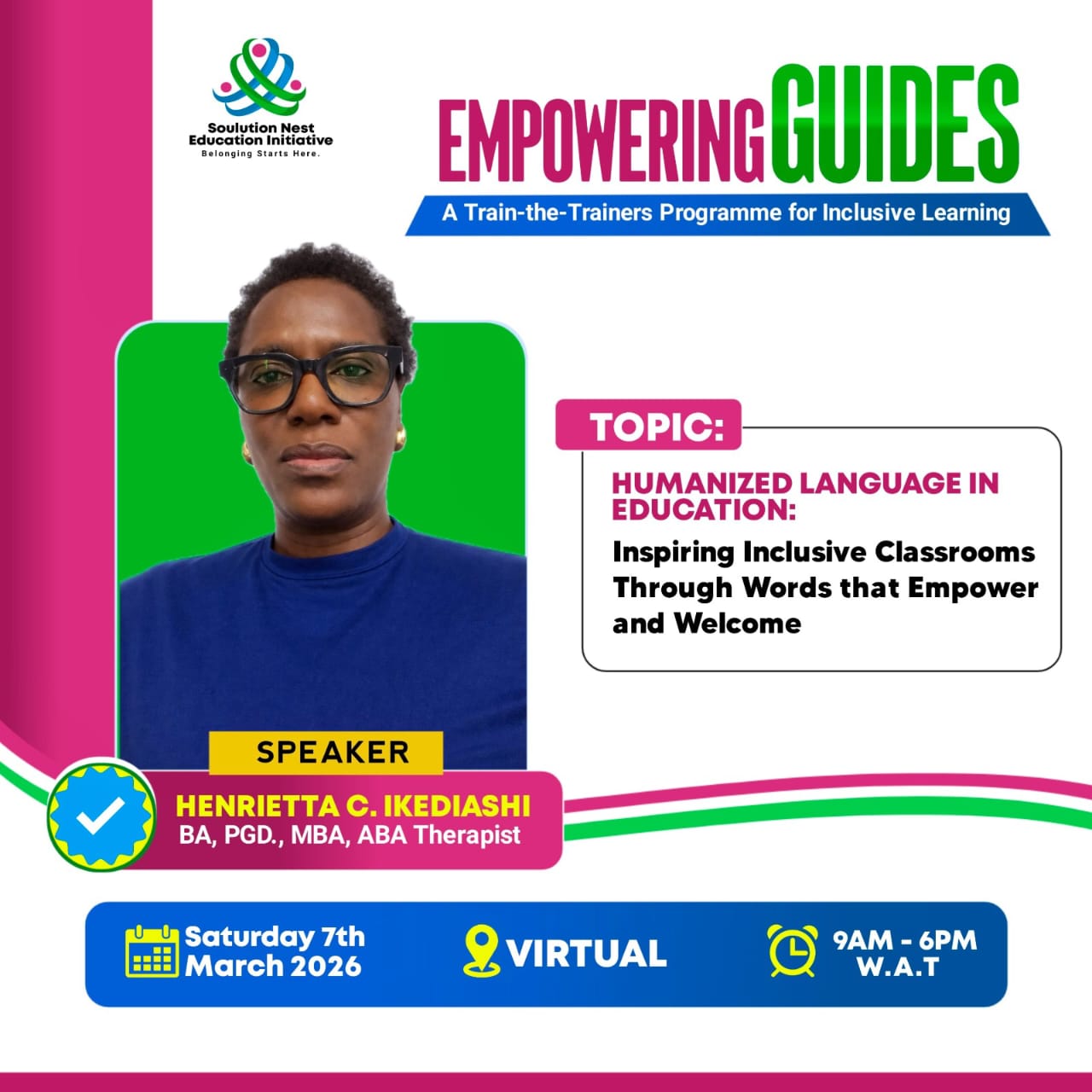
On Saturday, March 7, 2026, the Soulution Nest Education Initiative (SNEI) made history by hosting “Empowering Guides: A Train-the-Trainers Programme for Inclusive Learning,” a landmark virtual event that drew participants from across continents and delivered nine hours of transformative, expert-led training on inclusive education for children with special needs.
The programme ran from 9 AM to 6 PM West Africa Time and stands as one of the most significant gatherings of inclusive education expertise ever convened for a Nigerian audience. It was not a conference of speeches. It was a room full of practitioners, parents, therapists, educators and policymakers learning, in real time, how to change what happens to vulnerable children inside classrooms and homes across this country.
The scale of the problem this programme is tackling cannot be overstated. According to the 2024 State of Disability Inclusion Report, jointly launched by the National Commission for Persons with Disabilities and Project Enable Africa, Nigeria has an estimated 35 million persons with disabilities, of whom between 5 and 7 million are children. Of those children, 70 percent are currently out of school entirely. More than 85 percent of Nigerian schools are not accessible to students with disabilities. Nigeria’s own Education Digest data reveals that across the entire country, only 571 special needs primary schools exist, with just 8,800 teachers to serve 131,958 enrolled children. Every figure in that paragraph represents a child failed by a system that never prepared the adults around them to help.
Empowering Guides was convened to begin changing that, one trained practitioner at a time.
A Faculty of World-Class Specialists
The programme assembled nine internationally credentialed experts spanning Nigeria, Dubai and the United Kingdom, each bringing deep specialist knowledge directly relevant to Nigeria’s inclusive education realities.
Olufunke Amos, mni, a retired Assistant Director General with the the Federal Government and Fellow of the Security Institute, served as Moderator, guiding nine hours of sessions with precision and warmth. Olufunke Amos is also a member of the Board of Trustees of SNEI, alongside fellow trustee Oluwaseyi Esther Alabi.
Ms. Anju Bhatia, Founder and Chief Executive Officer of Future Wise Education in Dubai, delivered the session titled “Parent Empowerment: Equipping Parents with Confidence and Practical Tools to Support Their Children’s Growth.” Her session drew on her extensive international experience building parent capacity across diverse education systems.
Henrietta C. Ikediashi, Founder of SNEI and a certified ABA Therapist holding a BA, PGD and MBA, presented on “Humanized Language in Education: Inspiring Inclusive Classrooms Through Words that Empower and Welcome.” Her session challenged every educator in the room to examine not just what they teach but how they speak, and what that language communicates to a child about their worth.
Mr. Wael Al Awabdah, a Psychological Counsellor from Damascus University, holder of an MSc in Applied Behaviour Analysis from the Florida Institute of Technology, and the first Syrian to attain the BCBA certification, presented on “Behavior is Communication: Responding with Compassion.” His session reframed challenging behaviour as a child’s most honest attempt to be understood.
Ms. Ololade Adedoyin Naomi, an ABAT Certified Specialist holding a BSc in Economics with Early Childhood Education from the University of Lagos, an MSc in Economics from the University of Lagos, and a QABA certification in Applied Behavioural Analysis, presented on “Reinforcement Strategies from the Nigerian Perspective in Comparison with Global Practices.” Her session was widely praised for bridging international frameworks with the lived realities of Nigerian classrooms and homes.
Dr. Prince Agwu, PhD, Applied Social Policy Expert, delivered a session on “Developmental Governance and Community Responsibility Towards Inclusion in Nigeria.” His presentation made the case that inclusive education is not the sole responsibility of teachers. It is a governance mandate that requires community structures, policymakers and institutions to act.
Mr. Ransom Kadju Nghum presented on “Speech and Communication: Practical Ways to Support Children with Speech Delays and Communication Challenges,” equipping participants with immediately applicable strategies for one of the most commonly misunderstood areas of special needs support.
Ms. Ruba Samoul, BCaBA, trained at Damascus University and the Florida Institute of Technology with an MSc in ABA from the University of Massachusetts Boston, explored “Sensory Room and Self Regulation: Enhancing Learning Through ABA and Global Practices,” demystifying sensory integration for educators and caregivers who had previously lacked the tools to respond.
Technical excellence throughout the nine-hour programme was provided by Ololade Olakunle Olalekan, Head of the Technical Team and ICT and Learning Development Specialist, whose work ensured seamless delivery across time zones and geographies.
Each session ran for 40 minutes, followed by 20 minutes of structured interactive dialogue, allowing participants to ask questions, share experiences and directly engage with the experts. Certificates of participation were awarded to all attendees at the close of the programme, recognising their commitment to inclusive learning.
The Impact in the Participants’ Own Words
The numbers from Season 1 of Empowering Guides speak with precision: participants recorded a 43 percent average increase in knowledge scores from pre to post assessment. Eighty-nine percent stated strong intention to adopt and implement the strategies they learned. The programme received a 4.7 out of 5 satisfaction rating. The 54 trained professionals who completed Season 1 collectively support an estimated 3,350 children with special needs.
But the numbers only tell part of the story. The voices of those in the room on March 7 tell the rest.
One educator reflected that Henrietta Ikediashi’s session on humanized language gave them “a new lens to see every child as worthy of dignity.” A participant responding to Naomi’s presentation said that “for the first time, I saw how Nigerian realities can align with global practices.” A policymaker who attended Dr. Agwu’s session stated: “Governance is not just policy. It is responsibility, and this training showed me how inclusion must be embedded in community structures.” A parent shared: “I now feel equipped with tools to support my child’s growth with confidence.” A speech therapist responding to Ransom Kadju Nghum’s session said the communication strategies presented “will change how I work with children who struggle to express themselves.” An ABA practitioner reflecting on Wael Al Awabdah’s presentation said: “Understanding behavior as communication has reshaped my approach to compassion and intervention.” A school leader described Ruba Samoul’s session by saying: “Sensory regulation is no longer an abstract concept. It is a practical tool I can implement to enhance learning.”
Participants did not merely attend. They were transformed. And transformation travels. Each person who left that virtual room more equipped than when they entered carries that knowledge back into a classroom, a therapy room, a home, a policy document, or a community meeting where a child’s future is being decided.
The Organisation Behind the Movement
Soulution Nest Education Initiative was founded by Henrietta C. Ikediashi, ABA Therapist, educator and advocate, whose personal and professional commitment to inclusive education has driven SNEI from its founding vision to this international stage. The organisation operates under the motto “Belonging Starts Here,” and it means it. SNEI exists on the conviction that every Nigerian child with special needs deserves a trained, informed and compassionate adult in their corner.
The Board of Trustees includes Olufunke Amos, mni, and Fellow of the Security Institute, and Oluwaseyi Esther Alabi, whose contributions to the governance and direction of the organisation have been foundational.
Looking Ahead
The overwhelming response to Season 1 has confirmed that this work is urgently needed and deeply welcomed. Educators, parents, therapists and policymakers who participated are already clamouring for Season 2. SNEI is committed to expanding the reach of Empowering Guides through further virtual intensives, onsite workshops across Nigeria, and an International Conference on Inclusive Education that will put Nigeria on the global map as a leader in this field.
Educators, parents, policymakers, advocates, corporate organisations and institutions that wish to be part of what comes next are encouraged to reach out directly. The next chapter of this movement is being written now.
About Soulution Nest Education Initiative
Soulution Nest Education Initiative (SNEI) is a Nigeria-based organisation dedicated to promoting inclusive education and strengthening support systems for children with special educational needs. Founded by Henrietta C. Ikediashi, SNEI works with educators, parents, therapists, caregivers and policymakers to close the knowledge, practice and advocacy gaps that leave millions of Nigerian children without the support they deserve.
Contact:
Henrietta C. Ikediashi
Founder, Soulution Nest Education Initiative
Email: h.ikediashi@soulutionnestedu.org
Phone: +234 803 513 4227
Website: www.soulutionnestedu.org
