



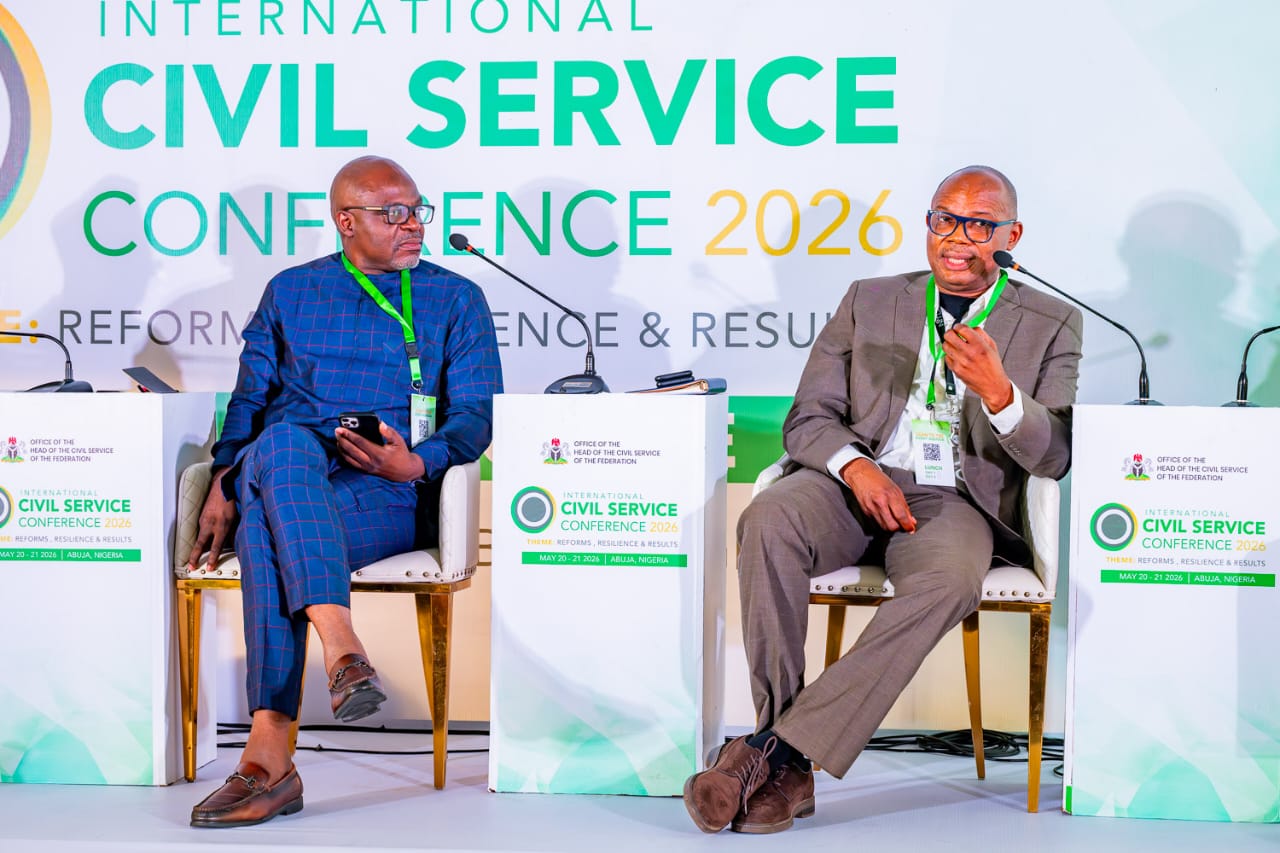
Rep of DG NITDA, the Director, SMP Department, Dr Aristotle Onumo giving insights into effective public service delivery through digital transformation at the ICSC 2026.
The Director General of the National Information Technology Development Agency, Kashifu Inuwa CCIE, has called on public institutions and organisations to embrace Artificial Intelligence (AI) responsibly while prioritising human accountability, policy frameworks, and digital skills development.
The NITDA, who was represented by the Director, Stakeholder Management and Partnership department, Dr Aristotle Onumo, speaking at the International Civil Service Conference 2026,disclosed that the Agency has already begun implementing a comprehensive AI Transformation Plan designed to reposition the organization for long-term institutional efficiency, continuity, and productivity, held at the Eagles Square in Abuja, recently.
“In NITDA as an agency, we have what we call the AI Transformation Plan. It is a kind of three-year plan which we have put in place so that even if the current staff are replaced completely, new personnel should be able to interact with the system and continue work without hindrance,” he stated.
The DG explained that the Agency has already integrated AI into its internal workflow processes, particularly in document management and task tracking. He noted that official documents submitted at the Agency’s premises are now scanned immediately at the gate and automatically routed by AI systems to the responsible officers based on identified keywords and subject areas.
The three-year transformation initiative is aimed at creating a digitally driven institution where operations can continue seamlessly regardless of personnel changes. The AI infrastructure also monitors timelines and flags delays where officers fail to attend to official correspondence within stipulated periods, he added.
“All that is required now is to drop documents at the gate. AI scans and routes them to the appropriate officers. If such documents are not treated within the required timeframe, the system flags them and reports accordingly,” he explained.
NITDA DG, stressed that the technology should be viewed as a tool for improving productivity rather than a threat to human relevance, while acknowledging concerns surrounding AI adoption, particularly fears about job displacement.
“There is always this fear that AI is coming to take away jobs, especially in the public service. But I want to state clearly that the jobs of people who refuse to upskill themselves may eventually be affected. However, those willing to retrain and adapt will benefit immensely from AI,” he said.
To address workforce transition concerns, he revealed that NITDA has commenced agency-wide AI capacity building programmes for all staff members. According to him, employees whose traditional roles are being transformed by automation are being reassigned and redesignated into emerging AI-related functions.
“We have ensured that everyone undergoes AI training. Those who previously handled manual file operations have now been redesignated as AI assistants and AI administrators. We are preparing our workforce for the future rather than replacing them,” he noted.
The DG, emphasized the importance of maintaining human oversight in AI deployment, warning against the complete removal of human intelligence and accountability from governance systems. “You must not take away human monitoring and accountability in any AI implementation process. At the end of the day, someone must remain accountable,” he cautioned.
Speaking on governance and regulation, the NITDA boss called for all Ministries, Departments and Agencies (MDAs) to develop internal AI policies capable of defining clear operational boundaries for the technology.
According to him, government deployment of AI differs significantly from private sector usage because public institutions must bear responsibility for any AI-related failures or ethical breaches. The need for robust governance frameworks to guide responsible AI use, protect citizens’ rights, and ensure compliance with data protection regulations.
“We must ensure that whatever we use AI for aligns with data protection regulations and responsible use principles. Without proper frameworks, data misuse could become more prevalent and destructive,” he warned.
The NITDA DG also highlighted the Agency’s broader efforts to drive national AI adoption following the development of Nigeria’s National AI Strategy, which he described as one of the country’s most forward-looking digital policy documents.
He stated that NITDA is currently using the Agency as a practical AI sandbox to test implementation models before wider deployment across the public service ecosystem.
As part of efforts to deepen digital capacity across government institutions, he disclosed that NITDA is collaborating with the Office of the Head of Civil Service of the Federation to train civil servants in digital literacy and AI-related competencies.
He reiterated that the future workforce must embrace continuous learning and adaptability to remain relevant in an increasingly AI-driven world.
“AI has not come to replace people completely. But those who refuse to develop their skills may struggle to fit into the evolving technology ecosystem,” he concluded.
