



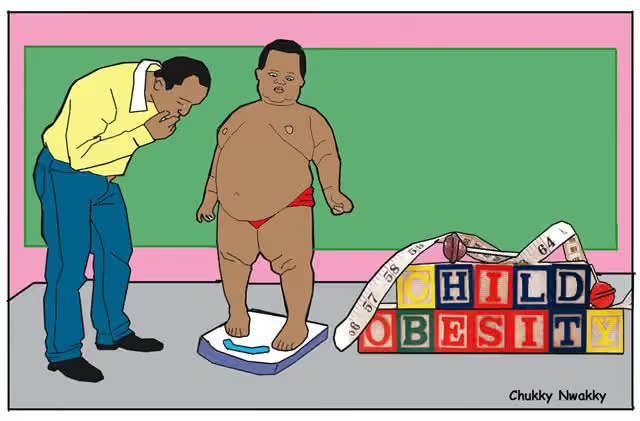
From the first meal of the morning to school break and after-school snacks, biscuits, sweets, sugary drinks and other packaged foods have become a regular part of many Nigerian children’s diets. While parents cite convenience, affordability, availability and children’s preferences, child health experts warn that frequent consumption of such foods increases children’s risk of diabetes and obesity. JANET OGUNDEPO reports
“My boy can drink six packs of a children’s-sized juice in a day,” a baker and mother of two, identified only as Boluwatife, said.
The 150ml juice has become a pacifier for her 18-month-old son, who gets it whenever he becomes restless, allowing her to focus on her tasks.
When Boluwatife’s children wake up, she gives them a cup of water and a healthy breakfast, but the day is filled with consuming several wraps of biscuits, sweets, and drinks.
In their lunchbox, the baker packs several snacks and drinks alongside the homemade food she carefully prepares for her four- and one-year-olds.
But the mother of two has begun to notice that the frequent consumption of the snacks and drinks is affecting her son’s eating habits.
“He eats less and takes junk food frequently. He does not eat normal nutritional food; he now prefers snacks,” she said.
Although Boluwatife told PUNCH Healthwise that she ensures her children eat fruit daily, she described their consumption of packaged snacks as “too much.”
Despite the quantity of these products her children consume, the baker and mother of two said she has never checked the nutritional value.
Instead, she checks only the “production and expiry dates.”
Unarguably, because Boluwatife does not check the nutritional value of each packed and processed juice and snack her children consume, she is unaware of how much sugar her under-five-year-olds consume.
Illness after consuming unnamed drink
Sometime in May 2026, a mother of three and resident of Yaba in Lagos State, Mrs Ada Chukwuka, noticed her four-year-old son had been using the toilet frequently. She wondered what had caused the loose stool and runny stomach.
After asking her 10-year-old about what her youngest child had bought as snacks on his way to school, she learned of an unbranded juice the child had bought.
Chukwuka eventually went to the store where the children had bought the juice, and she discovered that the product was unbranded and unnamed, leaving her in the dark about the ingredients, nutritional value, production and expiry dates and the manufacturer’s location.
The Yaba resident told PUNCH Healthwise that her preschooler suffered from diarrhoea for four days and she had to take him to the hospital as he began to appear weaker by the day.
That episode brought fear into her heart about the safety of what her children consumed, but the ease of getting the snacks and the more time it affords her to engage in personal tasks are perks that have hindered her from weaning her children off the snacks.
“I wonder how this drink got into the stores of those who usually sell things to children. I was really bothered when I saw the colour of the drink and package,” the Yaba resident said.
What WHO says
The World Health Organisation recommends that children limit their daily intake of free sugars to less than 10 per cent of their total energy intake, with an ideal target of below 5 per cent for additional health benefits.
Furthermore, WHO and pediatric guidelines advise that children under 2 years of age should not consume any sugar-sweetened beverages or foods with added free sugars.
The agency noted that consumption of free sugars is a major risk factor for overweight, obesity and dental caries.
Findings by PUNCH Healthwise reveal that many children’s products contain sugar, sometimes above the recommended threshold by regulators.
Convenience fuelling intake
Some Nigerian mothers who spoke with PUNCH Healthwise said that biscuits, sweets, sugary drinks and other packaged snacks have become an easy answer when children are hungry, restless, throwing tantrums or simply demanding a treat.
For some, the products are convenient school snacks, while others use them as rewards for good behaviour, to pacify children or keep them occupied.
But as the snacks become a regular part of children’s routines, some mothers are noticing that their children are beginning to eat less of their proper meals.
For a remote worker in Lagos, Victoria Nwahiri, packaged snacks are a regular feature of her three-year-old daughter’s school lunchbox.
The child eats cereal or bread and tea for breakfast before leaving home. At school, her lunch may include rice, spaghetti or noodles with fish and egg, accompanied by biscuits and juice.
When she returns home, she eats whatever the family is having, including swallow and soup, akara and bread or rice.
But while her mother is conscious of the contents of some packaged foods, she admits that convenience, price and her daughter’s preference influence what goes into the child’s lunchbox.
Nwahiri said she checks nutritional information on food packs but does not always check for the National Agency for Food and Drug Administration and Control number.
“I checked for the nutritional value information, but NAFDAC number no,” she said.
The mother said she was aware that some packaged foods contain unhealthy sweeteners that could harm children when consumed excessively.
“Yes, I do,” she responded when asked if she knew about the potential harm from unhealthy sweeteners.
Despite this awareness, her daughter consumes biscuits, juice, and other packaged snacks during school days, with such foods going to school with her about five days a week.
Nwahiri also admitted that she sometimes uses juice or similar treats to pacify her daughter.
“A time it happened was when she came across the pack of juice and insisted I give her one of them. I had to, because she wouldn’t stay still,” she said.
A mother of one and entrepreneur, Sabirat Murtala, said her child eats biscuits every day, while sweets and sugary drinks are given less frequently.
She said convenience and availability were major reasons she relied on packaged snacks, particularly when her child was throwing tantrums.
“I think what made the package attractive is the convenience and definitely the availability, because I can easily buy it and keep it in the house to give to the child any time he throws a tantrum or just to keep him busy,” she said.
The Alimosho resident said the child’s typical day begins with milk, followed by pap, while biscuits or sweets may be taken in the afternoon. Other meals include plantain porridge or other solid food prepared at home, with biscuits or cheeseballs sometimes served as evening snacks.
Murtala said the child also eats eggs, cereal at night and drinks water between meals.
Another mother, who identified herself as Adedoyin, a stay-at-home mother living in Port Harcourt, also said convenience influenced her decision to give her children packaged snacks.
She said her children take pap and milk before school, eat rice for their morning meal, and may have leftover rice, yam, beans or pasta for lunch, while dinner is usually eba with vegetables.
However, she said packaged snacks remained part of their school-day routine.
“Every school day. We no longer take juice,” she said when asked how often her children consumed biscuits, sweets, sugary drinks or other packaged snacks.
Adedoyin admitted that she sometimes uses snacks as a reward.
“When I’m going out, I promise to buy them snacks, if they don’t quarrel before my return,” she said.
Adedoyin said she was concerned that her children could feel excluded because other children consumed packaged snacks.
“Other kids take them in school, and I don’t want my kids to feel left out,” she said.
Adedoyin recalled an incident involving a small yoghurt drink in a blue package she gave her “first son. He vomited and purged for 2 days.”
Adedoyin, however, said she does not check the nutritional information of whatever snacks she gave her children, adding that she was aware that some packaged foods and drinks could contain unhealthy sweeteners.
For Mrs Temitope Olamide, a self-employed businesswoman who lives in Asese, packaged snacks serve a different but equally familiar purpose.
Olamide, who has a nine-year-old son and a one-year-old daughter, said she gives her children biscuits, sweets and drinks but tries to limit their intake because she knows that some of the products may contain unhealthy sweeteners.
“Yes, I know. That is why I didn’t give them essence. I used to give them once a day,” she said.
Her children’s day begins with breakfast such as custard, tea and bread. She prepares meals such as rice and plantain for school and adds biscuits or cookies to their lunchboxes.
At home, she may give them bread and butter after school before preparing dinner for the family.
Although she said the children eat proper meals, snacks have become part of their school routine, particularly during break periods.
“At home, I used to give them once,” she said, adding that they consume more snacks while in school.
Olamide also gives her children pocket money and says she instructs them on what they can buy. However, she acknowledged that children could still use the money to buy snacks while at school.
Her decision to include snacks in her children’s routine is partly driven by a desire to ensure they do not feel excluded when they see other children eating them.
She explained that snacks were often treated as refreshments after meals rather than substitutes for food.
According to the mother, the school’s short break has also become associated with snack consumption.
She added that buying snacks is also a way of making her children happy and strengthening the bond between them.
“It makes them happy, and it fosters closeness to their mother,” she said.
What NAFDAC says
The National Agency for Food and Drug Administration and Control Marketing of Foods and Non-Alcoholic Beverages to Children Regulations 2024 sets nutrient thresholds for foods and beverages marketed to children.
Under the regulation’s nutrient profile model, marketing is prohibited where products exceed specified sugar thresholds per 100g or 100ml, depending on the category.
It sets the threshold for total sugars in chocolate and sugar confectionery, energy bars, sweet toppings and desserts, cakes, sweet biscuits, pastries and other sweet bakery products, including cookies and breakfast biscuits, to 6g per 100g. Punch
