



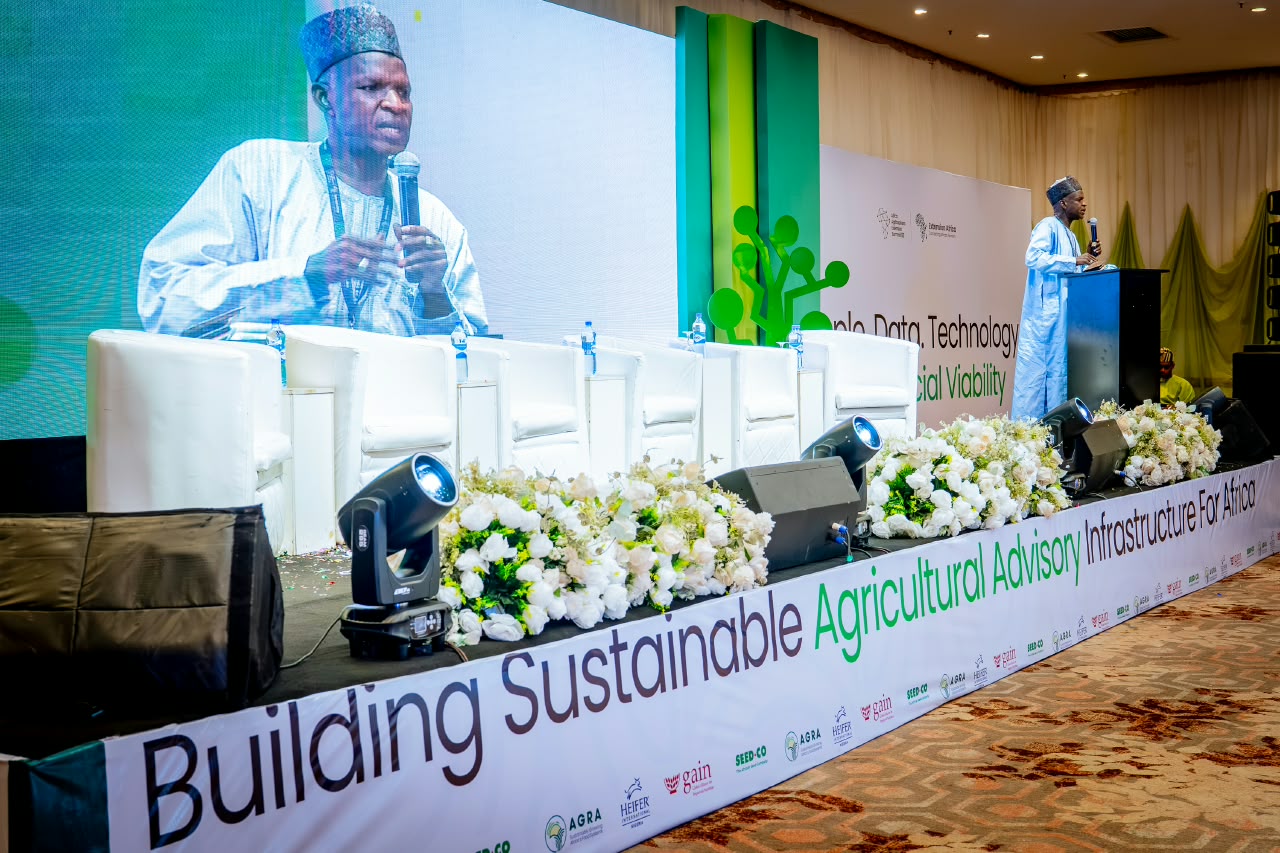
The Director General of National Information Technology Development Agency (NITDA), Kashifu Inuwa, represented by the Director, e-Government, Engr. Salisu Kaka, delivering his remarks at the Africa Agribusiness Extension Summit (AAES) 2026, organised by Extension Africa in partnership with NITDA in Abuja.
The National Information Technology Development Agency (NITDA) has called for the development of integrated digital infrastructure to expand agricultural extension services and provide millions of Nigerian farmers with timely and reliable information.
At the Africa Agribusiness Extension Summit (AAES) 2026, the Director General of NITDA, Kashifu Inuwa, CCIE, made the call, organised by Extension Africa in partnership with NITDA in Abuja.
Represented by the Director of e-Government, Engr. Salisu Kaka, Inuwa said Nigeria could no longer rely solely on conventional face-to-face extension services to meet the needs of its growing farming population.
Emerging technologies, particularly Artificial Intelligence (AI), could complement the existing extension workforce by connecting farmers with advisory services regardless of location, he said.
According to him, the focus should be on developing an interconnected digital ecosystem rather than creating isolated platforms. He identified interoperability, scalability, security and reliable data as essential to building effective digital agricultural services.
Inuwa highlighted AI’s potential to analyse agricultural trends, provide recommendations and support early-warning systems that could help farmers respond to emerging threats.
The Minister of Agriculture and Food Security, Abubakar Kyari, similarly advocated increased investment in digital agricultural extension services to modernise farming, improve productivity and strengthen food security.
The conventional extension system had weakened over the years, with the ratio of farmers to extension agents increasing significantly in many areas. He therefore called for digital platforms that could deliver weather alerts, market information, crop-disease advice and other agricultural information through mobile phones and other channels, Kyari said.
The Minister stressed that digital solutions must be designed around farmers’ realities and should complement, rather than replace, conventional extension services. He also called for greater investment by state governments, increased participation of young people and deliberate efforts to reach women farmers.
Improving productivity among millions of farmers would be critical to meeting Nigeria’s rising food demand, adding that better access to agricultural knowledge and advisory services could contribute to improved livelihoods and food security, Kyari noted.
The Chief Executive Officer of Extension Africa, Tajudeen Yahaya, said the organisation was established to address gaps in Africa’s agricultural extension system and strengthen last-mile advisory services.
Yahaya identified people, data, technology and partnerships as key pillars for building an effective extension system. He called for stronger collaboration among government, private-sector organisations, development partners and technology companies to overcome fragmentation in agricultural extension.
Extension Africa, established in 2021, had grown to about 7,000 extension workers across 16 states and reached more than one million farmers, he said.
The summit was aimed at developing measurable benchmarks and practical solutions for strengthening Nigeria’s agricultural extension system through improved human capacity, reliable data, technology and sustainable partnerships, Yahaya said.
