



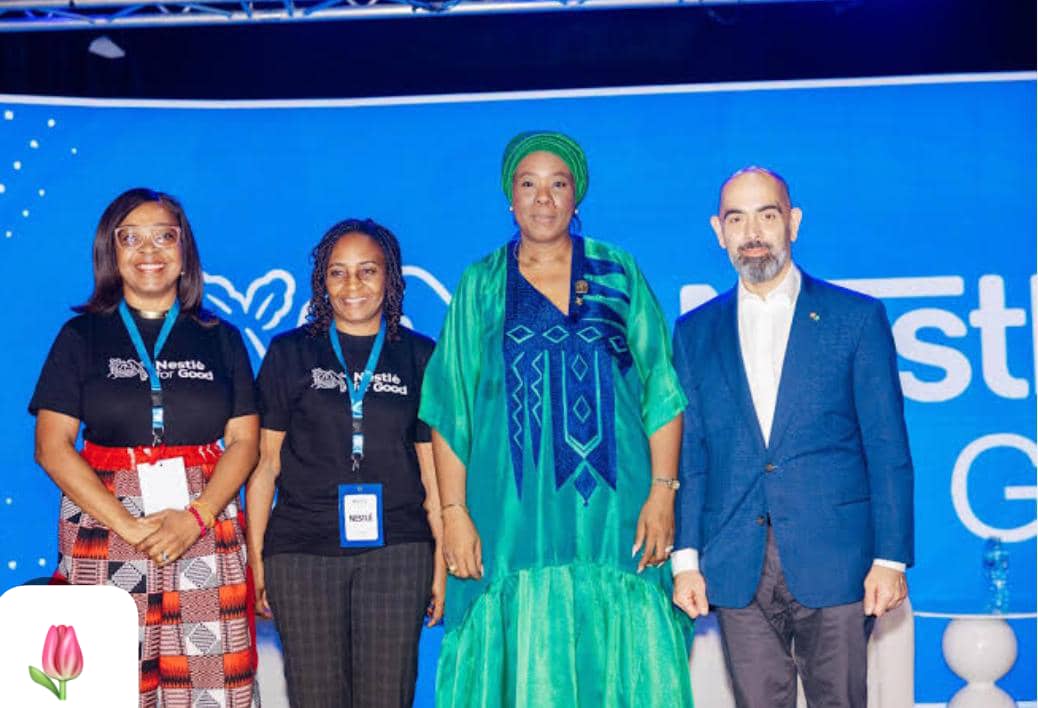
On Thursday, May 21, 2026, Nestlé Nigeria hosted the “Nestlé for Good Summit” at the Landmark Event Centre, Oniru, Lagos, bringing together government officials, industry leaders, healthcare professionals and development partners to address critical issues surrounding nutrition, sustainability and economic growth.
The summit emerged as a major policy and development platform focused on food security, sustainable livelihoods and collaborative strategies aimed at strengthening Nigeria’s nutrition systems while protecting the environment.
Participants at the high-level gathering emphasised the urgent need for stronger partnerships between public institutions, private organisations and development agencies to improve nutrition outcomes, reinforce agricultural supply chains and drive sustainable economic development.
In his opening remarks, the Managing Director and Chief Executive Officer of Nestlé Nigeria, Mr. Wassim Elhusseini, stated that the company remains guided by its purpose of unlocking the power of food to improve quality of life for both present and future generations.
According to him, Nestlé has continued to create shared value in Nigeria for more than five decades through responsible sourcing, local manufacturing and strategic investments targeted at improving nutrition security and community development.
He explained that the “Nestlé for Good” initiative reflects the company’s long-term commitment to nutrition, thriving communities and environmental sustainability.
“Progress towards a sustainable food and nutrition system can only be achieved through effective collaboration among governments, industries, healthcare institutions, development partners, communities and individuals,” Elhusseini said.
The summit also featured a fireside conversation led by Nestlé Nigeria’s Corporate Communications, Public Affairs and Sustainability Lead, Victoria Uwadoka, alongside Patricia Ekaba, who described the “Nestlé for Good” initiative as a strategic movement designed to deepen social impact, strengthen transparency and advance sustainable development goals.
They noted that the initiative aligns with Nestlé’s Creating Shared Value model, which seeks to connect business growth with social progress and environmental responsibility.
Ekaba further highlighted how Nestlé’s interventions across West Africa, particularly in Ghana and Côte d’Ivoire, have positively transformed the lives of beneficiaries through livelihood support programmes that restored economic stability, dignity and renewed confidence within communities.
The keynote address was delivered by the Honourable Commissioner for Commerce, Cooperatives, Trade and Investment in Lagos State, Mrs. Folashade Bada Ambrose-Medebem, who stressed that nutrition remains central to sustainable development because healthy populations contribute more effectively to economic productivity and national growth.
She noted that nutrition extends beyond food consumption and directly impacts healthcare systems, labour productivity and economic advancement.
According to the Commissioner, Lagos State continues to implement policies aimed at strengthening food distribution systems, improving the ease of doing business and supporting enterprise growth.
She disclosed that Lagos accounted for more than 60 per cent of Nigeria’s non-oil exports, valued at approximately $5.3 billion in 2024, describing the figure as evidence of the state’s expanding economic capacity.
Ambrose-Medebem highlighted two flagship programmes under the Ministry of Commerce, Cooperatives, Trade and Investment aimed at supporting small businesses and strengthening food systems.
One of the initiatives, the Lagos State Access to Finance for SMEs through Cooperatives (LASMECO), is a ₦10 billion financing scheme implemented in partnership with the Bank of Industry. The programme provides non-collateralised loans of up to ₦10 million at a nine per cent annual interest rate for cooperative-based micro, small and medium enterprises.
She explained that the programme also includes a six-month moratorium, a 36-month repayment structure, mentorship support and market access opportunities for participating businesses.
The Commissioner further referenced the Lagos State Export Readiness Programme (LASERP), implemented in partnership with African Export-Import Bank and ImpactHer, which has already trained more than 253 MSMEs on export procedures and opportunities under the African Continental Free Trade Area framework.
According to her, the state aims to generate an additional $1 billion in annual foreign exchange earnings through SMEs within the next five years.
She also revealed that the Lagos State Industrial Policy 2025-2030 was introduced to strengthen Lagos’ position as a leading manufacturing hub through infrastructure development, innovation support and stronger public-private partnerships.
Agric Services Manager at Nestlé Nigeria Plc, Edwin Aguda, disclosed that the company’s grains programme in Northern Nigeria currently integrates over 18,000 smallholder farmers into formal agricultural supply chains, with projections to increase participation to 25,000 farmers by 2027.
He described the programme as a strategic intervention designed to improve rural livelihoods while strengthening local food production capacity.
Participants at the summit observed that expanding local agricultural production remains essential to reducing Nigeria’s dependence on imported food and vulnerable international supply chains.
Nestlé Nigeria’s Sustainability Manager, Chinwe Obi, explained that sustainability initiatives are now deeply integrated into the company’s operational strategy.
According to her, Nestlé Nigeria has incorporated 50 per cent recycled plastics into its water bottle production process as part of broader efforts to reduce environmental pollution and improve waste management systems.
She added that the Food and Beverage Recycling Alliance has grown significantly from four founding organisations to forty-three participating institutions and has recovered more than 400 tonnes of plastic waste since 2019.
A major panel session at the summit, themed “Bridging Nutrition Gaps Through Coordinated Approaches,” was moderated by Amaka Nwaora of the Nutrition Society of Nigeria.
During the session, experts raised concerns over increasing cases of anaemia among women and stunted growth among children across Nigeria.
Health professionals at the summit also warned that diabetes, obesity and hypertension are rising rapidly due to poor dietary habits and weak nutrition awareness.
Panelists argued that Nigeria currently faces a dangerous double burden of undernutrition and non-communicable diseases, citing weak policy implementation, inadequate financing and fragmented institutional coordination as major barriers affecting nutrition programmes nationwide.
The summit further highlighted the importance of human capital development and economic empowerment initiatives.
Several beneficiaries of Nestlé-supported programmes shared testimonies on entrepreneurship support, vocational training and skills acquisition initiatives that positively transformed their livelihoods.
Abene Titilayo, a trader, explained how financial literacy training improved her business confidence and strengthened her economic independence.
A dairy programme beneficiary also described how structured support initiatives helped stabilise rural value chains and improve household income generation.
Another participant, who graduated from the Nestlé Technical Training Centre, recounted her experience during the 18-month programme, which focused on leadership development and industrial sustainability knowledge.
A trainee further shared how international exposure in Switzerland enhanced expertise in emissions reduction and sustainable industrial practices.
The summit concluded with a strong consensus that Nigeria’s food and nutrition challenges require integrated and long-term systemic reforms involving government, industry stakeholders, healthcare professionals and local communities.
The event ended with a vote of thanks delivered by Toju Egbebi, Corporate Affairs Manager at Nestlé Nigeria Plc, who expressed appreciation to participants, partners and stakeholders for supporting the summit and advancing conversations around sustainable nutrition and economic growth.
