



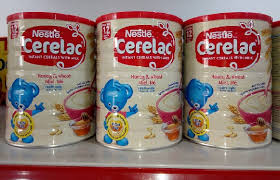
Baby food
Early and in the late 60s, nursing mothers in Nigeria proudly fed their babies with local cereals, mostly after a year or a bit more of exclusive breastfeeding.However, as modernisation crept in coupled with the coming of western media, particularly television dotting Nigerian homes, things started to change. Breastfeeding mothers started relying basically on ready made, and factory processed baby foods.
But the turn of the millennium made things even worse. Most mothers, particularly, career ones, abandoned breastfeeding entirely.
Despite the warnings of medical practitioners and World Health Organisation, the culture continued unabated as more and more types of baby food kept flooding the markets on a daily basis.
However, the economic downturn has brought many things back to old ways of life. The cost of buying baby food, just as other products is not for the financially-weak.
A peep into market showed that the cost of baby food like Cereals ranges from N20,000 to N50,000 per tin depending on the brand.
Economy&Lifestyle has discovered that most Nigerian breastfeeding mothers, particularly those with average income are now returning to feeding their babies with homemade meals.
They’re making alternatives like potato, rice, banana, purees, semolina, amala and ewedu (yam flour and jute leaf) soup among other things to feed their infants.
Mrs. Doris Erabor, a factory worker and a nursing mother said: “I make semolina paste, add milk and salt to feed my four-month- old baby. For two months, I couldn’t afford the baby food which price has increased.“I was very worried because I don’t want to go for new brands which can pose health risk for my child.
“I started feeding him with pap (corn meal). I work at a factory and the pay is not much. A few weeks before resuming work, I was thinking about what kind of food would sustain him because the pap wasn’t helping at all. So, a friend introduced me to semovita and milk.
“This has really helped feed my baby and we are seven months old now.”
Having a baby in Nigeria is now more expensive than buying a plot of land.
Costs of delivery, baby clothes, diapers and the most important of all feeding have all risen by over a hundred percent compared to few years back.
The high cost of living coupled with low purchasing power and poverty have gradually erased the six months mandatory breastfeeding of infants (baby friendly) for nursing mothers.
Working double shifts and running two to three businesses to meet up with piling expenses is now the ordor of the day. This has made nursing mothers exclude baby friendly and embraced baby foods.
However, as prices of goods and services are increasing by the day, price of baby food is not left out.
Mrs. Grace Osunde, a teacher, explained that it wasn’t easy because she had twins and her breast milk wasn’t flowing at all despite all efforts to increase it.
“We started to buy baby milk from day one after child birth.
“In a week, my twin finished two cans of milk.
“This baby milk was expensive. I was very very worried because my husband and I are managing.
“I teach in a private school. So, the expenses of having two babies, birthing and feeding them was taking a toll on him. At three months, I had to seek other alternatives.
“I cook rice and mash it until it is very soft, then I will add milk and banana to make a puree.I tried the corn, guinea corn, soya beans, groundnut and crayfish paste at first but my babies rejected them.Apart from the puree, I am hoping to introduce ewedu and amala gradually as they get older.
“To buy baby food, and other baby items is a great task.If you don’t want to break a bank, you will need to think outside the box.”
Mrs. Ramat Yusuf, a trader, said: “My baby is four months old. I don’t have the money for baby food because it is very expensive.
“I have tried so many infant foods but she keeps rejecting them. Pap, which was what I was brought up with, this girl refused. So, I introduced semolina paste with milk she was purging. I stopped the milk and added banana to sweeten it. That was when she accepted it. Vanguard
