



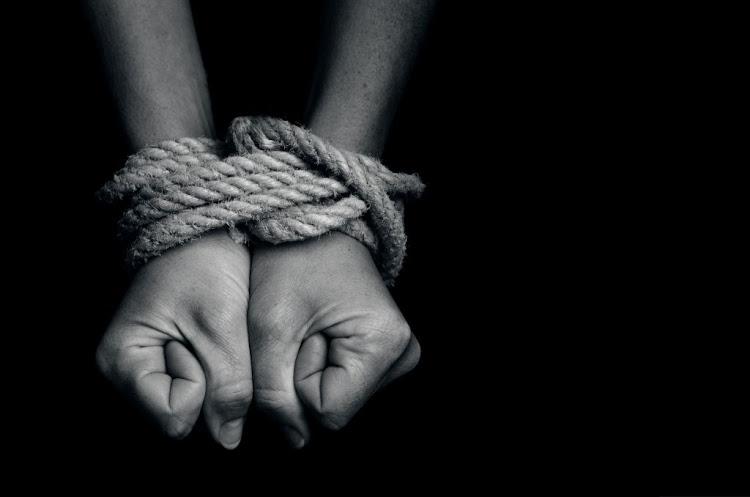
34780319 – hands of a missing kidnapped, abused, hostage, victim woman tied up with rope in emotional stress and pain, afraid, restricted, trapped, call for help, struggle, terrified, locked in a cage cell.
Security experts have accused commercial banks of encouraging the kidnapping epidemic in the country, as some ransoms are paid into bank accounts.
The experts and analysts, who have backgrounds in military, intelligence, and policing, also stressed that abductions had become an industry enabled by the financial institutions that received ransoms. They advised President Bola Tinubu and security to end the epidemic.
Previously restricted to the North-West, abductions have in recent times spread to other parts of the country, including Lagos, Ogun, Nasarawa, and Delta states, as well as the Federal Capital Territory, Abuja.
In the past weeks, several incidents of kidnappings have been reported in the FCT, with over 25 persons taken away by suspected bandits who demanded huge ransoms for their release.
Speaking on the complicity of banks in the growth of the abduction business, the Managing Director of Beacon Consulting, Adamu Kabiru, affirmed that banks were involved in collecting ransoms.
Speaking in an interview on TVC, the security and risk consultant categorically stated that two banks were involved in two kidnap-for-ransom cases, which he was aware of.
He said, “ I will shock you today to tell you that in almost all the cases where my company was involved, the money was collected through our banking system, and I say this with a sense of responsibility. In almost all, it was only in very few circumstances that cash was collected and taken to these guys (kidnappers).
“They are so brave and bold that they provide account numbers. Two banks are guilty, and because this is a public forum, I will not mention the banks’ names.
“But of course, if the security agencies are interested and they listen to this, I will be happy to provide it to them if they don’t already know.”
He urged the financial regulators to live up to their billing by ensuring the ‘Know Your Customer’ policy is effectively implemented by banks.
Adamu said, “So, even our financial regulators have a responsibility to ensure that banks play the Know Your Customers element very well.
Know Your Customers
“If they play that KYC element very well, it will be very easy, for instance, to descend on those account numbers and, of course, arrest whoever is the holder of that account. But as of today, that has not been done.”
The former intelligence officer noted that the Money Laundering Prohibition and Prevention Act 2022 prohibits individuals and corporate bodies from paying or receiving cash payments exceeding N5m and N10m, respectively.
The law provides for 24-hour timeframes for all financial institutions or designated non-financial institutions to file suspicious transaction reports with the Nigeria Financial Intelligence Unit.
Adamu admonished the security managers to “wake up from their slumbers’’ insisting they had the technical capacity to track the kidnappers.
The obstacle to rescuing the victims, he explained, was the fear that the abductors could kill the victims.
He said the nation lacked the tactical ability to rescue the hostages, noting that this could be achieved with good intelligence and well-trained personnel who could carry out multi-faceted rescue operations.
Speaking in an interview with The PUNCH on Sunday, Adamu stressed that the payment and withdrawal of money paid for ransom could not be made without the involvement of some bank officials.
He said the industry was “fed” by a line of other businesses, including informants, weapons and ammunition suppliers, and the “vulnerabilities that exist in our banking system.”
He added, “One can conclusively say that a kidnap-for-ransom industry exists in Nigeria and that it is a thriving one. The industry is fed by a value chain that includes businesses like informants, weapons and ammunition supplies, drugs and essentials supply etc.
“It also includes those who assist them in collecting and laundering the proceeds. It is a security and financial issue. Some of the drivers of abduction are the socio-economic issues and the vulnerabilities that exist in our banking system.’’
“The financial sector in Nigeria remains a vulnerable point for money laundering and the financing of illicit transactions and terrorism. Details of this are in the last GIABA review of Nigeria’s compliance with global protocols and standards on money laundering and financing or terrorism.
“As an example, banks still have a comfortable number of their staff members supplied by third-party contracts and the issue of KYC,” he submitted.
‘Kidnapping now business’
Corroborating Adamu’s position, a retired Commissioner of Police, Emmanuel Ojukwu, hinted that the banks might be complicit in the kidnapping business.
Ojukwu said, “Crowd-funding for ransom payment has been hyped. It is not a pleasant solution; it sort of reinforces the crime. The banks are probably involved in all of this, for how do such funds get pooled, and where do they end?
“Bank customers have been finding it tough to get cash for their transactions, how come millions are being sourced for kidnappers?
“I suppose that banks and NFIU should begin to ask questions on how these funds are trafficked and where they end up. There is technology to track such funds.’’
The Chairman of the Association of Corporate Affairs Managers of Banks, Rasheed Bolarinwa, could not be reached for comments on the allegations against the banks as of press time on Sunday.
However, a top official of the bank who chose to speak under condition of anonymity, because he was not authorised to speak on the matter, said the ransoms allegedly paid into some bank accounts might have been paid into tier-1 accounts with inadequate Know-Your-Customer requirements.
He said, “During the era of a former CBN governor, Lamido Sanusi, banks were allowed to open some accounts with little KYC requirements. These tier-1 accounts could be used to perpetrate such evil acts. However, I’m still not sure if that is possible because there is a limit to the amount that can enter such accounts. Only current or corporate accounts can handle huge amounts, often paid as ransoms. But the CBN is already handling these issues by asking bank customers to link their BVN to NIN before April ending.”
But Chidi Omeje, a security analyst, lamented that kidnappings had become a big industry, turning over billions in a matter of months.
He said, “It’s a huge industry, one of the biggest industries in this country. If we check the figures, we will discover that those guys have a monthly turnover of billions. So, it’s a huge industry and a very horrible one at that.
“I think it’s a pity that we have come to this level that such an odious enterprise is now becoming such a huge industry.’’
He argued that banks had contributed to the growth of the abduction industry “because most of the ransoms are not paid with cash.’’
Omeje said, “Of course, they (banks) are quite complicit because most ransom payments are not done with cash; they are done through bank payments and transfers or whatever.
“And do not forget there was a time when they said we should do these NIN and BVN, and they told us how they would use it to catch criminals. Can’t you see that nothing is happening?
“This is where offices like the NSA, EFCC, and DSS come in. We have a lot of agencies that should be on this, but nothing is happening. Are you telling me that the NCC cannot track phone numbers? Banks are complicit, and it is quite shameful.”
Also, a former Assistant Director in the Department of State Services, Mike Ejiofor, agreed that abductions had become an industry in Nigeria, adding that banks could collaborate with agencies to trace the kidnappers using marked monies.
“I remember that when (Ex-CBN Governor Godwin) Emefiele’s wife was kidnapped; money was marked, and it led to arrests. The problem is that most people paying ransom are weary of the security forces. If they collaborate to get some of the marked money, it could lead to arrests too.
“The money may not necessarily be from the Central Bank because it is not the Central Bank that gives them the money.”
