



Stakeholders call for cultural reorientation, state accountability and social protection for vulnerable families
The Federal Government says socio-cultural reorientation and accountability at the state level are critical to achieving its 2026-2030 National Action Plan for the Elimination of Child Labour, developed in partnership with the International Labour Organisation (ILO).
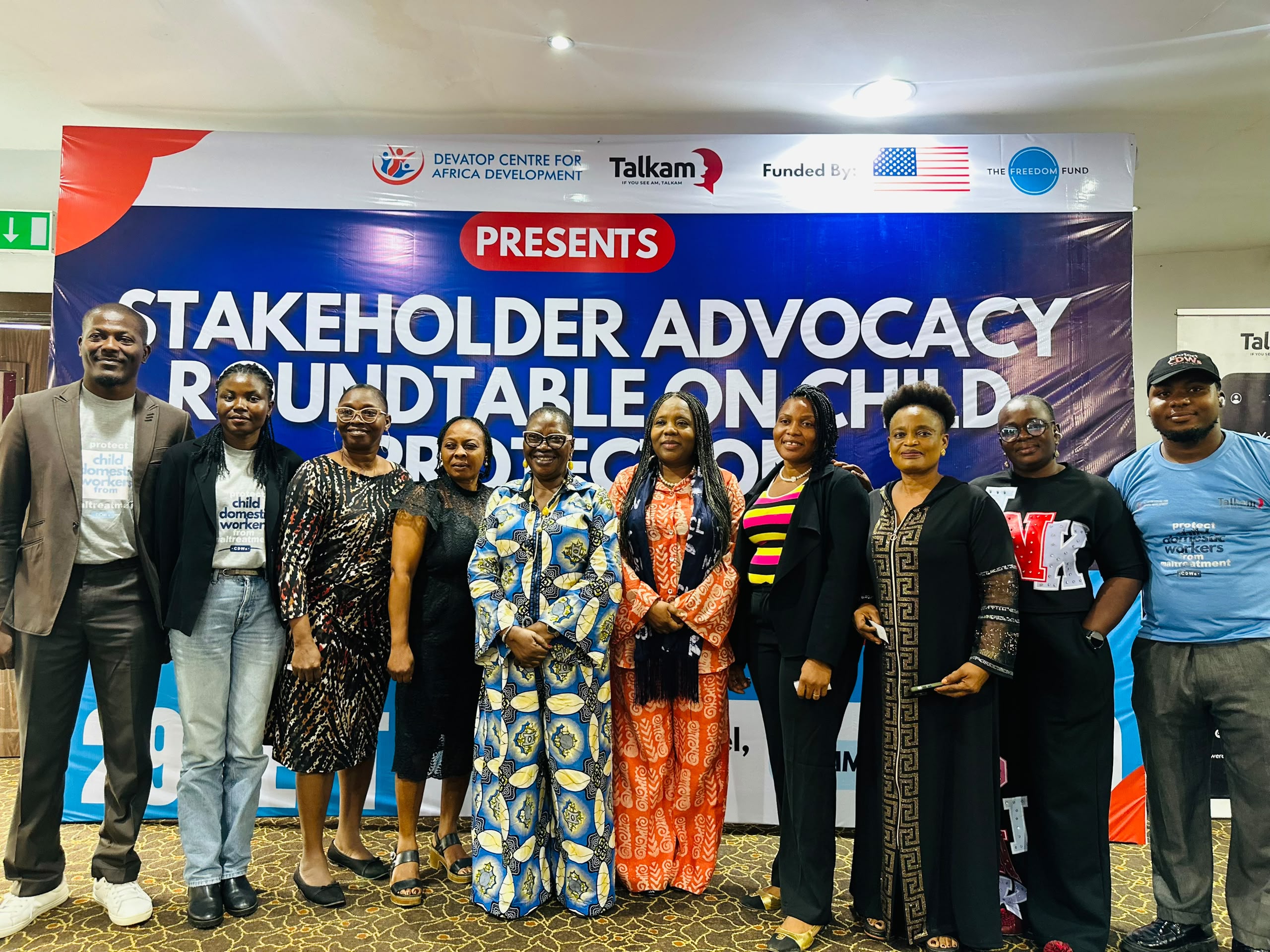
The position was canvassed on Tuesday in Lagos at a stakeholders’ advocacy roundtable on child protection with the theme: “Strengthening Coordinated Action to Eliminate Child Labour and Protect Children from Exploitative Domestic Work in Lagos.”
The roundtable was organised by Devatop Centre for Africa Development in collaboration with the Freedom Fund, with support from the United States Government.
Presenting the third phase of the National Action Plan, the Director, Inspectorate Department, Federal Ministry of Labour and Employment and Chair, National Steering Committee for the Elimination of Child Labour, Mrs. Olaolu Olaitan, said the ministry is partnering with the National Orientation Agency (NOA) and other stakeholders to drive behavioural change.
Mrs. Olaitan described child labour as any work that harms a child physically, emotionally or morally and deprives the child of education.
“Child labour is any type of work that is detrimental to the health of a child, any kind of work that is physically, emotionally, morally dangerous and harmful to a child, and that deprives that child of schooling. Most of the child labourers we have are in agriculture. Then we have high risk sectors, including mining, domestic servant service, informal urban work,” she said.
She noted that domestic work carries the highest risk of exploitation and called for expanded social protection for vulnerable households as a sustainable solution.
On her part, the Lagos Zonal Commander of the National Agency for the Prohibition of Trafficking in Persons (NAPTIP), Mrs. Comfort Agboko, charged citizens to take responsibility for sensitising their communities on the deceptive methods used to recruit children.
“I will encourage us not to be hearers alone. We should not just listen for the fun of it and not do something. I want to encourage us in our various fields of endeavours, in our homes, in our churches, in the market,” she said.
Mrs. Agboko warned that employing an underage child as a househelp is a criminal offence. “If a neighbour of yours has an underage child as a househelp, it is a criminal act. It’s an offence. There’s no ignorance under the law because if, for instance, you are arrested by NAPTIP, there is nothing like ‘Madam, I’m very sorry,’” she said.
Project Lead of Devatop Centre for Africa Development, Ms. Janet Homo, said the engagement was aimed at moving from policy to implementation.
“Our journey has connected community realities with government systems and national labour priorities. It is not just going to be policies. Those policies have to be implemented, and that’s why we are working in the grassroots, in the communities, and seeing how we can bridge some of the gaps that we saw before we started the project,” she said.
In a welcome address presented by Ms. Nora Nongu, the Chief Executive of the organisation said Devatop was proud to have contributed to the development of the National Policy and Action Plan 2026-2030.
The event also featured a panel discussion with the State Coordinator, Child Protection Network, Lagos, Mrs. Aderonke Oyelakin; Project Lead, CeCe Yara Child Advocacy Centre, Mr. Damilola Adenusi; and representative of the Lagos State Universal Basic Education Board (SUBEB), Dr. Bunmi Elabor, who agreed that institutional commitment and coordinated action between government and civil society are indispensable to ending child exploitation in Nigeria.
