



Seated underneath a makeshift tent woven from dried palm fronds and supported by decaying tree branches, Badiku Saliu, a nine-year-old pupil of LEA Nomadic Primary School, Yangoji East, on the outskirts of the Federal Capital Territory (FCT), balanced on a worn polyethene sack, as he scribbled and his eyeballs moved between the blackboard and his notebook.
Saliu, a nomadic boy, nodded at intervals as the teacher taught arithmetic, while shafts of sunlight slipped through the gaps in the fragile thatch over his head. Although he remained focused, he was no stranger to the situation because he had spent more than four years in the school and had learnt in extremely dire conditions under the sun, under the rain, and in the heat.
Crammed under a shade of trees that pass for a classroom, Saliu is not the only pupil affected; ninety-six other nomadic children are facing the same challenges and pursuing primary education despite the dearth of learning infrastructure.
“I don’t feel comfortable during rainy seasons, but there is nothing I can do, so I skip school,” Saidu said in Fulfulde. He pointed out that he is not encouraged to pursue formal education because of challenges such as the lack of classroom structures and infrastructure. The boy, who wants to become a teacher, was worried that his dream might not see the light of day due to the abject learning situation he has found himself in. Although Saliu now goes to school to fulfil his parents’ obligations, he is discouraged and constantly absconds from classes. For him, learning is hard because he struggles to concentrate due to the absence of infrastructure and the distractions that come with it. Most times, he battles either under the sweltering sun while buzzing flies perch on his frail skin for blood or at the mercy of the skies during a downpour.
But Saliu is not isolated in this struggle; ninety-five pupils at the school grapple with the same growing educational pain of neglect. LEA Nomadic Primary School in Yangoji East is not the only school facing an infrastructure dearth crisis.
Established in 2020, the school has not had any government intervention over the past six years, except for the files of the pupils and a sandy, allocated piece of land littered with makeshift thatch and rotten wood with rusted nails, waiting for the next blood to consume.
Across rural communities in the FCT, dilapidated classrooms and inadequate learning facilities have become a feature of many public primary schools. Despite the worsening conditions, government intervention remains limited as persistent neglect threatens the quality of basic education and pushes more children out of school.
TheCable found out that several other schools, such as LEA Primary School, Makanima; LEA Primary School, Kigbe; LEA Primary School, Takuru; and LEA Primary School, Gbagbalade, are bound by the same chain of crises.
Research showed that inadequate infrastructure in rural public schools across the FCT is linked to higher student dropout rates and lower attendance than in urban schools. It noted that there was an existence of a rural-urban divide across rural schools. While urban schools enjoy advantages in infrastructure, qualified staffing, supervision, and policy implementation, rural schools battle with neglect and severe barriers, another study revealed.
Teachers, tutors, and parents of the LEA nomadic primary school are fed up with the school’s situation. They believed that the poor state of the school had contributed to the number of dropouts.
“The state of the school is not suitable for learning for the children,” said Adamu Bauchi, a parent of five pupils who had lived in the settlement for four decades.
But Bauchi is left without a choice because there is no alternative school close by. He added that to support efficient teaching and learning, the government should provide a range of learning services.
“I ensure that my children go to school every day, even though learning occurs under trees. I want the government to provide boreholes, chairs, desks, tables, buildings, and other important things to aid learning,” Bauchi said, with a look etched with worries.
But there is more.
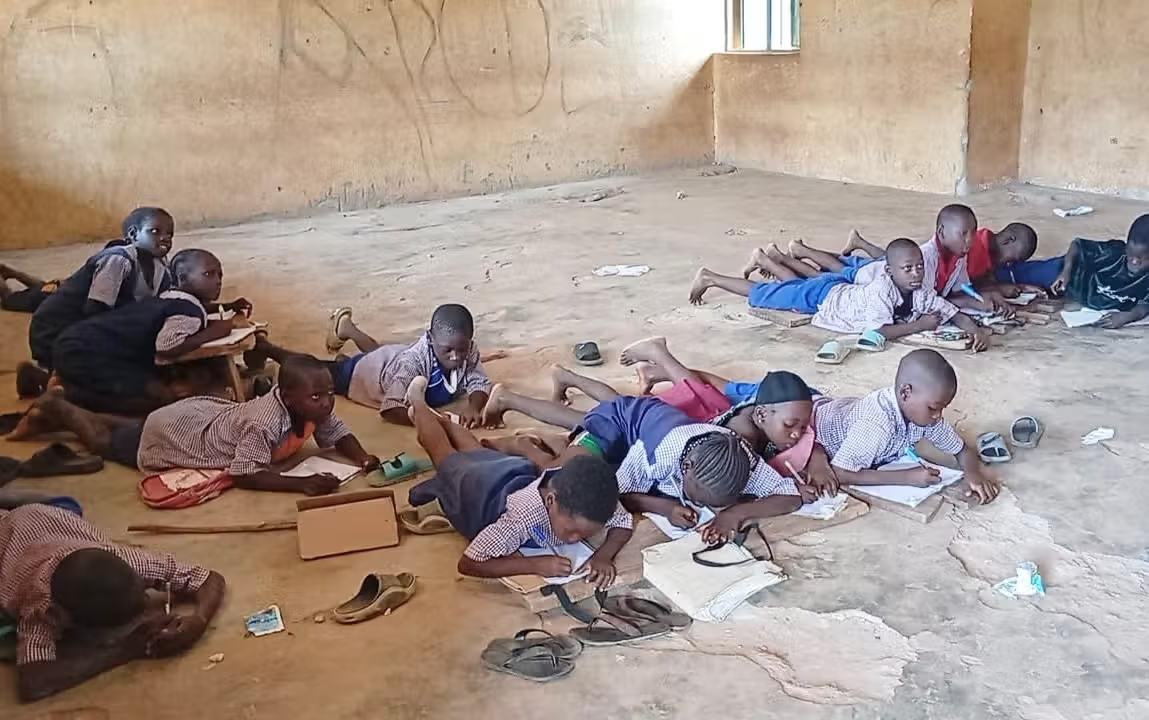
Ladi Danlami, school head teacher, confirmed that the dearth of infrastructure in the school has triggered a wave of dropouts among nomadic children. Danlami explained that the pupils of different classes are crammed together.
“We demarcated the school into two classes because of a lack of structure and seats. The students sit on the bare floor, and some who can provide sacks sit on them while the teacher sits on these benches,” she noted.
Advertisement
“The children and parents are discouraged, and they complain. We have also complained and written to authorities like the FCT Universal Basic Education Board and the Nomadic Commission.
“We divided the class in two to ensure that primary one, two, and three pupils sit on sacks. Primary 4 and 5 also sit on the floor.
“The school has nothing – no chairs, tables, or structures – and if rain falls, we cannot come to school, or we have to run home.”
Danlami said that both the FCT Universal Basic Education Board (FCTUBEB) and the FCT education secretariat are aware of the challenges facing the school. She explained that officials from the education secretariat visited the school on the same day TheCable visited, noting that the trip was part of the routine supervisory inspections regularly carried out by the secretariat.
Advertisement
She added that an official letter detailing the school’s plight was sent to authorities such as the nomadic commission, the FCTUBEB, and the local education authority (LEA).
“Even the number of students we have in school has reduced from what we used to have. We barely have anything in the school,” the headteacher said.
Studies showed that rural schools exhibited higher dropout rates and lower attendance, mainly due to poverty, child labour, and inadequate infrastructure.
IN KIGBE, NO CHAIR, NO DESK TILL PRIMARY FIVE
From afar, LEA Primary School, Kigbe, looked beautiful, but a closer look revealed cracks and ugliness hidden within its three blocks of classrooms. The school is unequipped with chairs and desks; so many pupils have to learn either by sitting or lying on the patchwork of the dusty, cracked floor until they get to primary four.
When TheCable visited the school in June, the classroom dust had become an uninvited companion, swirling through the air by midday and settling stubbornly on the pupils’ uniforms. While many children sat directly on the floor, others perched on broken wooden slabs, making do with the little the classroom had to offer.
A nine-year-old pupil of the school, Ibrahim Sheyemi, narrated the ordeal she faced while learning in such conditions.
“There are no chairs until primary 5. When I was in primary one, the pupils in primary 5 and 6 had chairs,” Sheyemi said.
Sheyemi, who is the headgirl of the school, explained that many of the chairs used in her present class are on the verge of destruction.
“We are only managing the chairs,” she quipped.
Pupils expressed deep frustration over the poor condition of their school, explaining how the lack of basic furniture has disrupted both their learning and daily lives. Many said they often leave school early to work on the farm because there are no chairs for them to sit on during lessons. They also lamented that sitting on dusty classroom floors leaves their uniforms badly stained, forcing them to wash them every day.
Corroborating Sheyemi’s story, Abdulrasak Aliyu, the headboy, said he lay down to write from primary one to primary four.
“I started writing on the desk in primary six,” he said.
Teachers are not spared from the school’s daily struggles. Beyond the struggle with an overcrowded learning environment, they also have to take turns to use the few available chairs after each lesson.
Dauda Dogara, the school’s desk officer, said the severe shortage of infrastructure has contributed to a high rate of absenteeism among pupils. According to him, many children sit or even lie on the bare floor during lessons, leaving some with chest pains and discomfort.
“I share the chair with my students, and we don’t even have a table,” Dogara noted.
“They often go back home after break,” he said, explaining that many pupils abandon classes before the school day ends. Dogara added that the number of school-age children staying at home now exceeds those attending classes. He added that there is no functional toilet, stressing that both teachers and pupils walk to the bushes to answer the call of nature.
Tunji Alausa, minister of education, said there are more than 20 million dropouts from primary school to JSS. The United Nations Children’s Fund (UNICEF) sounded an urgent alarm that crumbling school infrastructure is robbing millions of Nigerian children of a normal childhood and stunting their cognitive development, turning classrooms once seen as sanctuaries into places dominated by fear.
FOUR CHAIRS FOR FIFTY PUPILS: WHAT IT TAKES TO KEEP AN FCT PRIMARY SCHOOL RUNNING
While the challenges vary from one community to another, one crisis that cuts across many public primary schools in the FCT remains the chronic shortage of basic classroom infrastructure.
In LEA Primary School Ebo, the story is no different. The public primary school operates inside a mud-walled block with just two classrooms for all six grades. Neither the walls nor the floors are plastered or cemented, and the isolated school sits amid overgrown bushes.
The school is staffed by four teachers who have learned to work with almost nothing. In a school of more than 50 pupils, there are only five chairs, barely enough for the teachers, let alone the children.
Muhammed Dauda, a teacher, said the shortage of classroom furniture has become one of its biggest challenges.
“There are more than 50 pupils in the school, but many of them don’t come because we don’t have enough seats,” Dauda said.
He explained that the shortage affects teachers as much as it does pupils. With only five chairs available, teachers either squeeze together, stand outside under the scorching sun while a colleague teaches, or sit on their motorcycles.
“As you can see, the environment is not conducive. If not because it is government work, no one would leave the comfort of their home to come and sit here,” he said.
Beyond the infrastructural deficit, Dauda said the school’s isolation compounds its challenges. During the rainy season, many pupils who live across the river are unable to attend classes because there is no bridge, and rising water levels make crossing unsafe.
Though LEA Primary School, Gbagbalagbe, shared a similar plight, the school has more classroom blocks, and pupils are also crammed into the classes to learn.
LEARNING WITH PRAYER: LEAKING ROOFS, HANGING ZINCS LEAVE PUPILS IN FEAR IN MAKANIMA
Although LEA Primary School, Makanima, appeared to be one of the few fortunate schools, with a relatively new block of three classrooms from afar, the illusion quickly faded when TheCable visited the school. The building was already falling apart.
Segments of its corrugated zinc roof have been ripped away by wind and weather, leaving gaping holes overhead. Some dislocated zinc hangs, waiting for a strong wind to pull it off; others are still nailed to the woods and planks. Whenever it rains, the pupils, their books, and school bags get soaked.
On sunny days, the same openings invite the sweltering sun, turning lessons into an endurance test under sweltering heat. The teachers and headteachers are not excluded from this struggle; they either have to end the day’s lesson or get drenched by the rain.
Parents expressed their dissatisfaction regarding the present state of the school. Michael Monday, parent of a child who attends the school, lamented that its collapsed roof and damaged ceiling have disrupted learning and exposed pupils to unsafe conditions.
Monday said that although the classrooms are not enough because primary one to primary six have to cram themselves in three classrooms, the situation of the school makes learning not only difficult but dangerous for the pupils.
He noted that he had witnessed occasions when his son had to return home due to the leaking roof that cannot protect the pupils.
Pupils “learning” under a collapsed ceiling at LEA Primary School, Makanima, FCT
“I am not happy to see our community school like this. The ceiling, the zinc, and the entire roof are damaged. Even if the children arrive by 7 a.m., once it starts raining, they have to return home,” Monday lamented.
Alfred Katunga, head teacher of the school, said the deteriorating infrastructure has made teaching and learning increasingly difficult.
“It is not only the roof that is bad. The ceiling is also in a terrible condition and could fall at any time. We continue to teach while praying that none of the materials will fall and injure the children,” Katunga said.
He noted that rainfall automatically brings lessons to an end because every classroom, the teachers’ office and even the veranda leak, leaving no safe place for pupils and staff to stay.
He stated that the situation has discouraged school attendance, with some parents reportedly keeping their children at home for fear of possible injuries from the collapsing structure.
“Whenever there is any sign of rain, the only precaution we take is to close the school. Even if the children resume by 7 a.m. and rain starts 10 minutes later, we have to send them home because we cannot risk their lives,” he said.
Teachers are also affected, as many travel long distances from neighbouring communities only to have lessons cancelled due to rainfall.
“The teachers are demoralised. They spend time and money coming to work but cannot teach. When they try to catch up with the syllabus, they are forced to skip important parts of lessons, putting our pupils at a disadvantage compared to those in better-equipped schools,” he said.
Aside from the damaged buildings, the school also lacks basic facilities, including perimeter fencing and toilets. Katunga said the absence of toilets forces pupils to leave the school premises to relieve themselves, causing them to miss lessons, while teachers sometimes walk long distances to nearby bushes or the riverside.
He cautioned that the practice exposes both pupils and teachers to security risks and dangers such as snakebites in the surrounding bush.
He, however, appealed to the government to urgently rehabilitate the classrooms, provide sanitation facilities and fence the school to create a safe and conducive environment for teaching and learning.
TheCable reached out to Patience Agonsi, spokesperson for the FCT Universal Basic Education Board (FCTUBEB), for comments on the findings, but efforts to obtain a response were unsuccessful. Cable
