



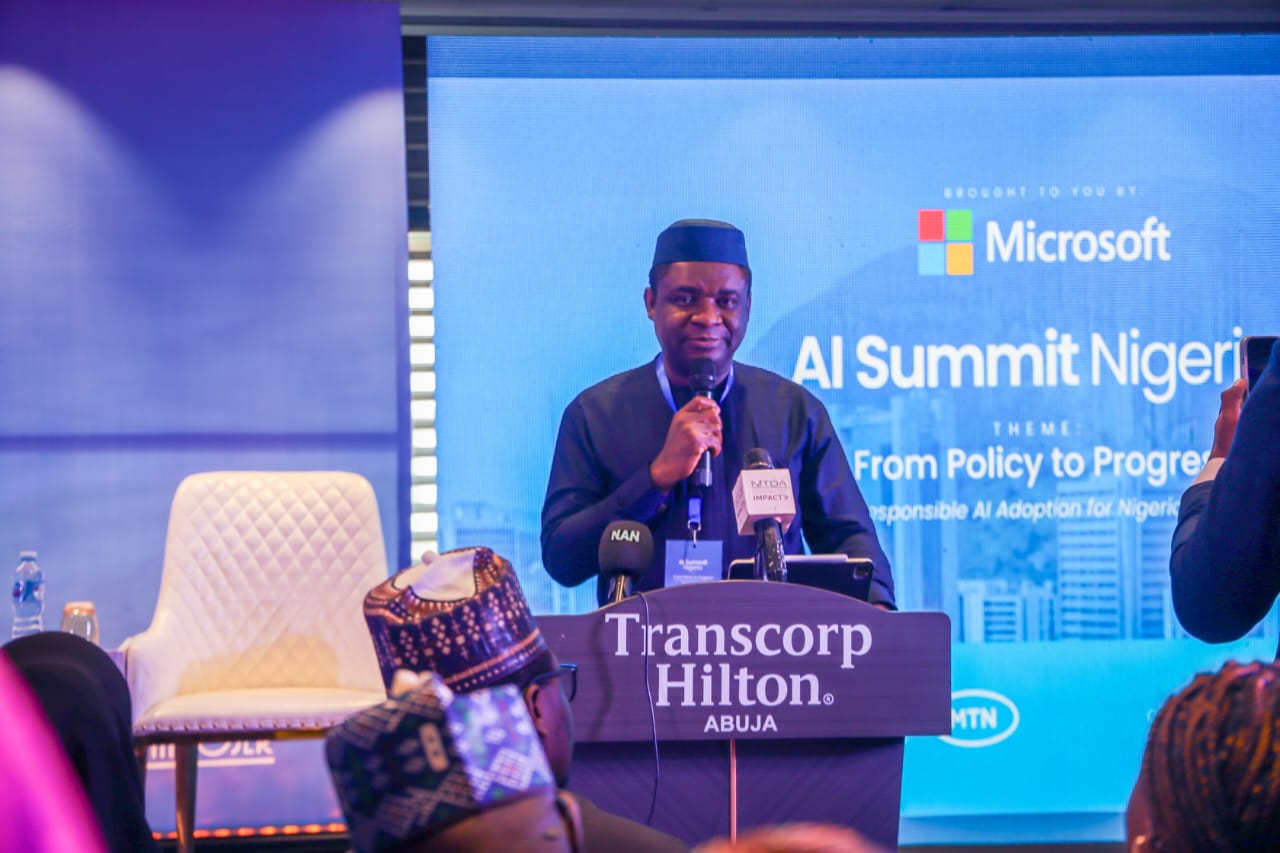
Represetative of Kashifu Inuwa Abdullahi, the DG NITDA, Barrister Emmanuel Edet, Ag. Director, Regulation and Compliance Department, delivering a remark at the AI Summit Nigeria 2026.
The National Information Technology Development Agency (NITDA) has reaffirmed its commitment to establishing Nigeria as a frontrunner in Africa’s artificial intelligence economy, emphasizing that the country’s digital future relies heavily on responsible AI adoption, digital sovereignty, and homegrown innovation.
NITDA’s Director-General, Kashifu Inuwa CCIE, speaking at the AI Summit Nigeria 2026, described AI as a transformative force capable of revolutionising every economic sector. His insights were delivered by Barr. Emmanuel Edet, NITDA’s Acting Director of Regulation and Compliance, who highlighted that trust serves as the bedrock for any sustainable AI rollout. Without a firm commitment to accountability and transparency, he warned, widespread innovation simply cannot scale, hosted by Microsoft in Abuja.
“Without public trust, AI adoption will be stalled,” “Without accountability, innovation will not scale sustainably, and without transparency, citizens will lose confidence in the systems designed to serve them, Inuwa noted..
Themed “From Policy to Progress: Accelerating Responsible AI Adoption for Nigeria’s Digital Decade,” the summit was a collaborative effort between Microsoft, NITDA, and MTN. The event brought together a diverse group of public and private sector stakeholders to map out actionable strategies for embedding AI into the fabric of Nigeria’s economy.
A central theme of Inuwa’s address was the critical need for Nigeria to achieve true digital sovereignty. He urged the nation to pivot from being mere consumers of global technology to becoming active creators of it.
“We must become creators of intelligence rooted in our realities and responsive to our aspirations,” Inuwa urged. “We must build local talent, strengthen research ecosystems and create an enabling environment where Nigerian and African solutions can thrive.” He added that Africa needs to play a defining role in shaping the global future of AI, rather than just adapting to technologies built elsewhere.
Microsoft’s Director of Government Affairs for West Africa, Nonye Ujam, also spoke at the event, praising Nigeria’s proactive steps in AI governance, particularly through the National AI Strategy and ongoing regulatory reforms. However, she challenged attendees to move past the paperwork and focus on executing AI solutions that yield measurable benefits for everyday citizens, businesses, and government operations.
Ujam pointed out that truly effective AI adoption hinges on robust governance frameworks, solid infrastructure, and institutional capacity, all while anchoring new innovations to the core principles of fairness, security, transparency, and accountability.
The summit sparked vital conversations around regulatory clarity, digital sovereignty, and the delicate balance between fostering innovation, driving collaboration, and maintaining strategic control over Nigeria’s fast-evolving tech landscape. The event drew active participation from key institutions, including the Nigeria Customs Service, the National Identity Management Commission, and Galaxy Backbone, all signaling a unified front for Nigeria’s digital future.
